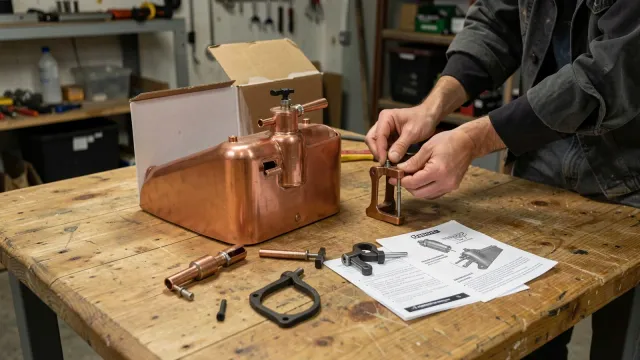
Copper Moonshine Still: How to Choose
A guide to choosing a copper moonshine still, including antiques and new kits, that starts with federal law rather than metal thickness or shop photos.
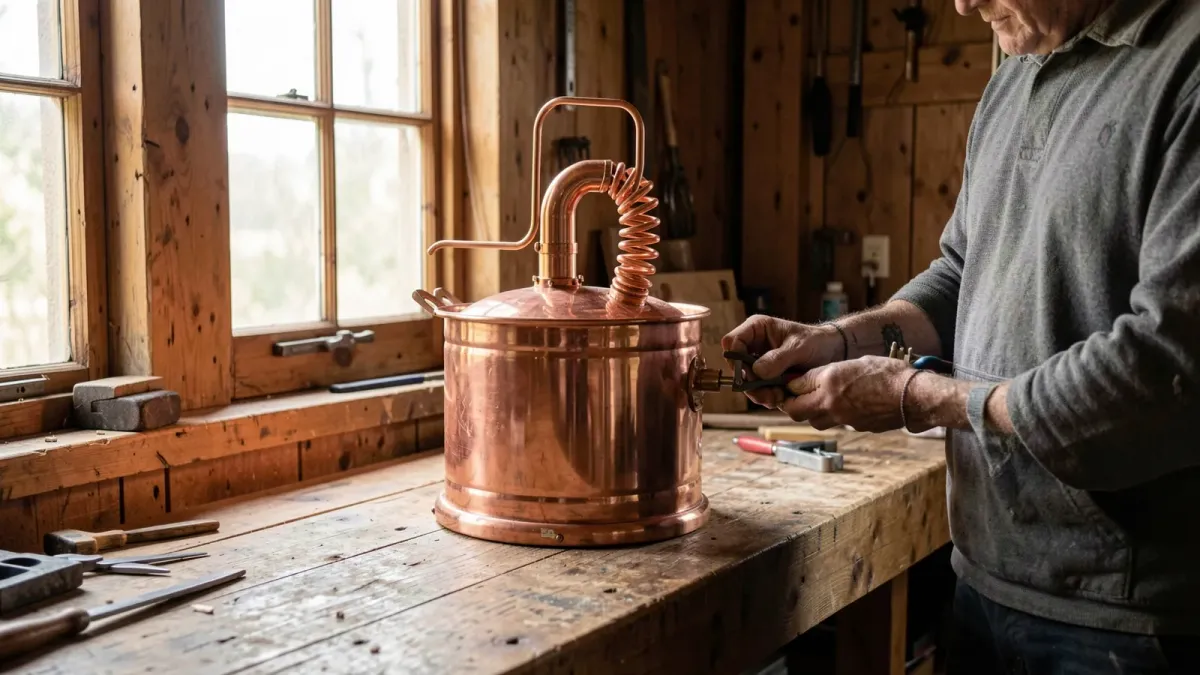
A copper moonshine still is a piece of equipment, not a permission slip
Copper has a romance problem. It photographs well, it shows up in historic stills and in licensed distillery tours, and it is the metal people type into a search box next to the word moonshine. A copper moonshine still, an old copper moonshine still, or an antique copper moonshine still can be a beautiful object. It is not a legal shortcut. Buying copper, or buying age, does not create a personal-use right to produce distilled spirits at home.
This is a how-to-choose article in a narrow sense. It will help you think about what you are actually buying, and what you must not use it for in a dwelling. It will not tell you how to operate a still, how to pack a column, or how to make liquor. If a seller's page moves from metal thickness straight into beverage production in a garage, leave that page.
The honest way to admire copper is the same way you might admire a locomotive: look at it, learn the history, visit a place where professionals use the real thing under qualification, and do not try to run one in the spare room.
What people are usually choosing among
Marketplace titles mix several different objects. Separating them is the first useful choice.
| What the listing calls it | What you may actually be looking at | A lawful way to think about it |
|---|---|---|
| New copper moonshine still | A newly made pot or kit, often sold with a coil, sometimes as "for legal uses only" | Do not buy it as a plan to make beverage spirits at home |
| Electric unit with copper parts | A heated appliance marketed with moonshine language or "essential oil" language | The metal and the power source do not change federal spirits law |
| Old copper moonshine still | A used object, sometimes incomplete, with unknown history | Age is not a permit; a still that can be put back into unlawful production is not a harmless antique by default |
| Antique copper moonshine still | A collectible, a display piece, or a relic with documentation of age | Buy it to display or study, not to recommission in a residence |
| Licensed distillery shop photo | Professional equipment on qualified premises | A tour and a bottled souvenir are the lawful version of the aesthetic |
You will see maker names on new copper and on reproductions. Treat the name as a label. Ask what you intend to do with the object, then ask whether that use is lawful under federal and state law.
Copper itself is used in professional distillation for reasons distillers on qualified premises can explain, including how the metal behaves with vapor and with certain sulfur compounds. That workshop fact is not an invitation to try it at home. It is a reason the metal shows up in photographs.
Myths that attach themselves to copper
Myth one: a heavier copper pot is "more legal" than a thin kit, because it looks professional. Legality does not scale with wall thickness.
Myth two: an antique copper moonshine still is exempt, because it is historic or was owned before a particular year. History can make an object interesting. It does not move household spirits production into a permitted category, and it does not make a residence into a distilled spirits plant.
Myth three: copper is required, or copper is forbidden, as a special legal category. Federal guidance on home distilling is about producing distilled spirits other than at a qualified plant, about unregistered stills, and about prohibited premises, among other offenses. The romance of the metal is not the rule.
Myth four: if a museum or a licensed distillery has a copper still, your kitchen can have a working one too. Those institutions are not your kitchen, and a display is not a household production right.
A choosing checklist that keeps the law in front
- You have read current federal guidance: producing distilled spirits at home is prohibited, and a residence cannot be a distilled spirits plant
- You are not choosing a copper still as a way to make liquor, whiskey, brandy, or "moonshine" at home
- If you want an antique or an old copper moonshine still, you want it as an object to display or study, not as a device to recommission
- You have checked state and local law as well as federal law
- You understand that "for legal uses only" on a product page is a disclaimer, not a TTB approval
- You will not follow a seller's or a video's operating steps for beverage alcohol in a dwelling
- If your actual interest is the look and the history, you have considered a clearly decorative piece, a book, or a visit to a licensed distillery
- If your actual interest is making alcohol at home, you are looking at wine or beer, where a limited federal exemption may apply, not at a still
If you cannot tick the first two lines, stop the purchase. A handsome copper pot is a very expensive way to make a legal problem.
If you still want copper in your life, keep it lawful
Visit a licensed distillery and look at copper where it belongs, on qualified premises, with people who are allowed to use it. Buy bottled spirits if what you wanted was a drink. If you are a collector of historic objects, buy from a dealer who can talk about provenance, condition, and display, and keep the object out of production. If you are a crafter who likes fermentation, spend the money on a wine or beer setup and a good hydrometer.
For anyone who is, in fact, involved in a TTB-qualified plant, equipment choices belong in that regulated setting, with the plant's own specifications and compliance obligations. This article is not a procurement guide for a plant, and it is not a substitute for 27 CFR Part 19 or official TTB equipment and premises rules.
The official public warning remains the one on TTB's Home Distilling page, with a shorter discussion in the Alcohol FAQs. Offenses listed under 26 U.S.C. 5601 include possession of an unregistered still and unlawful production of distilled spirits, and the bureau states that those offenses are felonies punishable by up to 5 years in prison, a fine of up to $10,000, or both, for each offense. Copper does not appear in that sentence as an exception.
Choose the metal for a lawful object, or choose not to buy. That is the whole decision.
Questions about choosing a copper moonshine still
Is an antique copper moonshine still safer to buy than a new kit?
It can be a better collectible, if you want a display piece and the object is truly a historic item. It is not legally safer if the plan is to put it back into beverage production at home. Age is not a permit.
Does more copper, or thicker copper, make a still better for home use?
Home use for producing liquor is not a lawful purpose in a residence, so "better for home use" is the wrong test. For a display piece, judge it as an object: condition, completeness, and whether you will keep it out of production. For a qualified plant, judge equipment under official rules, not under a marketplace title.
Can I hang an old copper still on the barn wall as decoration?
Displaying an object is a different intention from producing spirits. Even then, know what you own, and do not treat a wall hanging as a backup plan for a batch later. If you have questions about a particular device, use official TTB and state sources, or a qualified attorney.
What should I buy if I like the look of copper but I wanted a home alcohol hobby?
Buy wine or beer equipment, if household production of wine or beer is allowed under the rules that apply to you, and visit a licensed distillery when you want to stand next to copper. That combination gets you a lawful craft and a lawful view of the metal, without pretending a still kit is a kettle.